

Towing with an electric car : key considerations
Electric cars are inherently well-suited for towing, thanks to their engineering. With significantly more pulling power, or torque, available instantly compared to petrol or diesel vehicles, electric vehicles (EVs) handle towing with ease.
This instant power delivery also results in smoother driving, a major advantage when towing. Additionally, EVs tend to weigh more than their internal combustion engine counterparts, which enhances stability on the road when towing. That said, vehicle weights have generally increased across all types due to advanced safety features and technology, not just electric cars.
However, there are some important factors to consider when deciding if towing with an EV aligns with your lifestyle or work needs.
Towing range
Towing with any vehicle, whether petrol, diesel, or electric, reduces its range. However, the reduction in range with EVs is not as severe as some might expect.
According to tests conducted by Arval UK, towing reduces an EV’s range by approximately 14-23%. For example, if your EV has a real-world range of 400 kilometers, towing could reduce that to between 310-345 kilometers still plenty for most trips.
This reduction will naturally result in higher energy consumption, just like increased fuel consumption in traditional vehicles, meaning the cost per kilometer (mile) will increase.
Public charging challenges
Another key consideration when towing with an electric vehicle is the availability and accessibility of public charging stations.
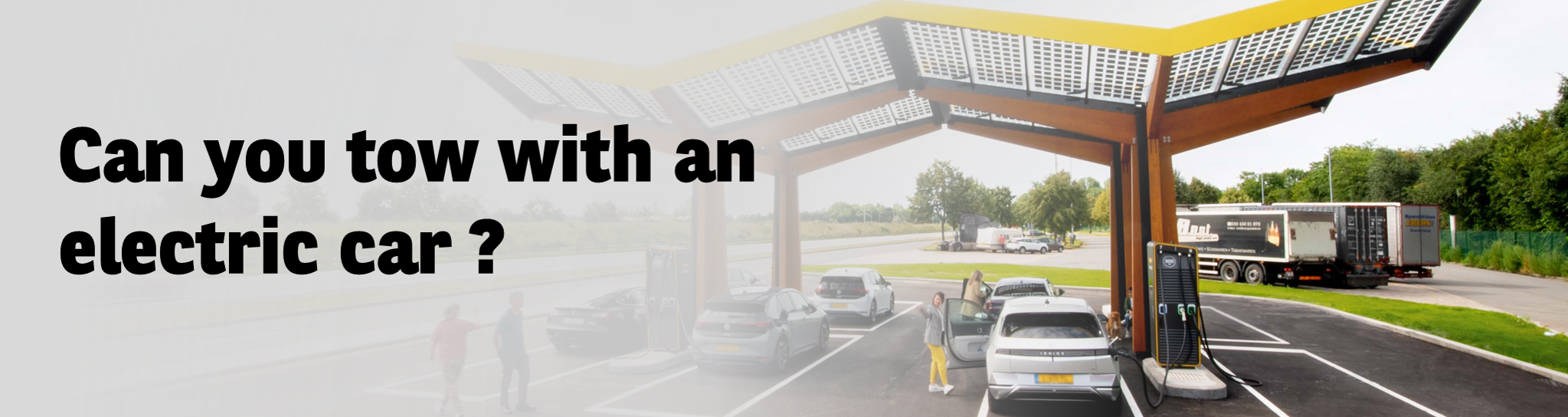
Frequent charging stops are to be expected due to the reduced range while towing, but currently, most public charging stations are not designed to accommodate vehicles with trailers, caravans, or horseboxes.
For those towing horseboxes, this may not pose a significant issue, as they typically charge their vehicles at home and stay local. However, caravan owners who travel longer distances may find it more difficult to charge en route. Most public chargers are designed for vehicles to park either forward or backward, which could mean that your trailer may extend into surrounding areas, or you may need to uncouple it before charging.
Fortunately, some charging networks are starting to address this issue. Providers like Gridserve, Mer, and SSE have developed charging solutions for larger vehicles, including electric heavy goods vehicles (HGVs), which could eventually benefit those towing with EVs.
Towing capacity
Towing capacity the maximum weight a vehicle can tow—is continually improving among electric cars. According to ev-database.org, 234 EVs can currently tow between 1T and 2.5T, while still maintaining a range of over 350 kilometers.
Some of the leading EVs for towing include larger 4x4 models like the BMW iX (2.5T maximum), Tesla Model X (2.3T maximum), and Kia EV9 (2.2T maximum), offering towing capacities comparable to those of large diesel SUVs.
Smaller EV models can also tow, albeit with slightly lower capacities that are still suitable for everyday use. Examples include the Volvo XC40 (1.8T maximum), Renault Scenic (1.1T maximum), and Skoda Enyaq (1.2T maximum).
Should you go electric If you tow?
There’s no one-size-fits-all answer. Each driver’s needs and circumstances will determine if an electric vehicle is the right choice for towing.
For those who only tow smaller loads over short distances, transitioning to an EV is likely to be smooth, provided the vehicle has sufficient towing capacity. However, for drivers who regularly tow heavy loads over longer distances, there are additional challenges to consider. As public charging infrastructure continues to evolve, long-distance towing with electric vehicles will become increasingly viable.


ALL INFORMATION IN ONE PLACE !