

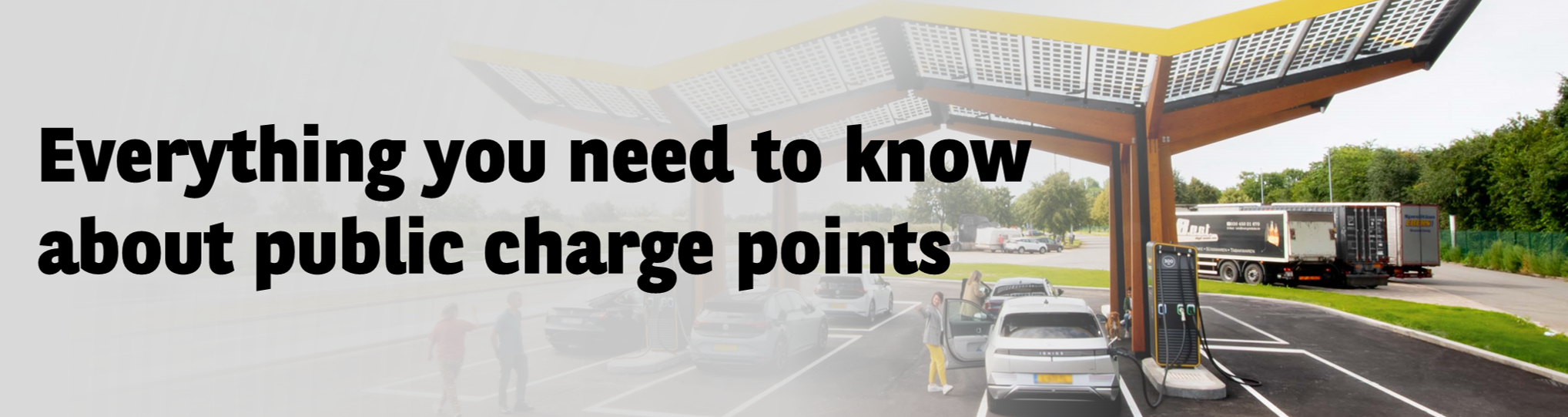
Running an electric car and charging it at home is straightforward and incredibly convenient, but what if you want to venture further afield ?
Home charging is sufficient for most daily journeys, especially with the ever-increasing range capabilities of modern electric vehicles (EVs). However, depending on your driving habits, there will be occasions when you’ll need to tap into the public charging network. For those who don’t have access to a driveway or a home charging station, public charging will become an even more frequent part of their routine.
Whether you’re already an electric car owner or considering making the switch, here’s a comprehensive guide to everything you need to know about public charging.
1. Connector types
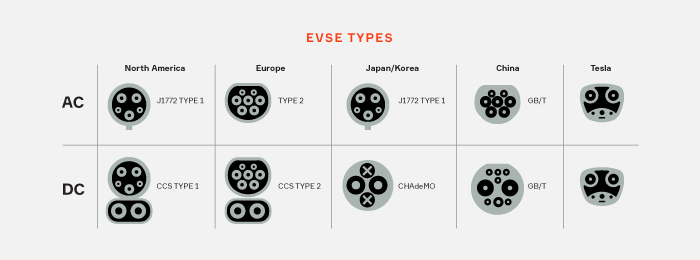
Europe is steadily moving toward a standard set of connector types for electric vehicles, making it easier for drivers to charge anywhere. The two most common connectors are Type 2 and CCS Combo (often referred to simply as CCS). Additionally, there’s the less common CHAdeMO connector, though fewer new vehicles are being designed with this option.
You might occasionally encounter older connectors like Commando and Type 1, as well as the ability to use a standard three-pin socket for charging.
CCS connections are typically the fastest and most widely supported for rapid or ultra-rapid charging, using direct current (DC) to supply power. CHAdeMO and Tesla’s Type 2 connectors are also classified as rapid or ultra-rapid.
For alternating current (AC) charging, Type 2 connectors are most common, delivering power at speeds between 7-22 kilowatts (kW). These charge points may come with a tethered cable, but more often, you’ll need to bring your own. Most new EVs use either CCS or Type 2 connections.
With rapid DC chargers, the cables are always attached, so you won’t need to worry about bringing one with you. Rapid AC chargers are also tethered and ready to use.
Slow charging typically offers speeds of 6kW or less and may require a three-pin socket, Commando, Type 1, or Type 2 connection. As with fast charging, you’ll usually need to bring your own cable for these points.
2. Speed of supply
Charging speeds are categorized into several tiers :
- Slow charging : Anything providing 6kW or less.
- Fast charging : Charging points offering speeds between 7-22kW.
- Rapid charging : This typically ranges between 50-150kW.
- Ultra-rapid charging : Anything from 150kW and up. The fastest public chargers currently available offer speeds of up to 350kW.
3. Charging speed
Navigating the different charging speeds can seem complicated, but there are a few key points to keep in mind.
A standard home charging unit generally offers 7kW, which takes about eight hours to charge a car with a 70kWh battery from 20% to 100%.
In the public charging network, a typical charge session often goes from 10% to 80%. With a 50kW public charger, that same 70kWh battery would take about an hour to charge from 10% to 80%. If you’re using a 100kW charger, the time could drop to less than 30 minutes.
It’s important to note that advertised charging speeds may not always reflect real-world conditions. Several factors can influence actual charging speeds, including how many vehicles are connected to the station, the ambient temperature, and the vehicle itself regulating the charge to protect battery health.
4. The charge curve
In every EV, charging speed isn’t constant. The fastest charging occurs when the battery is at its lowest charge, and as it nears full capacity, the charging rate slows down. This is called the charge curve.
Much like filling a glass of water, it’s quick at the start but slows down as you approach the top. This slow-down phase helps prevent battery damage and prolong its overall lifespan. Different EV models have different charge curves, influenced by the battery’s charge level, temperature, and how the manufacturer has designed the car to maintain long-term battery health.
5. Payment options
Most public chargers today support tap-to-pay functionality, with on-screen instructions guiding EV drivers through the process. While this method is the most convenient, it might not always be the cheapest. Some charging networks offer discounted rates for members or those who register for their services.
If tap-to-pay isn’t available, charging can typically be initiated and paid for through a mobile app associated with the charging provider. You’ll need to register and provide your payment details before using these systems.
6. Cost of charging
Charging on the public network is generally more expensive than home charging, particularly if you benefit from a low-cost off-peak tariff at home.
Public charging costs are usually tied to the charging speed: the faster the charging point, the higher the cost per kilowatt-hour (kWh). For example, a 350kW charging point is likely to cost more than a 22kW charger.
While there are still a few free public chargers, they are becoming increasingly rare.
According to Avere France, as of February 2024, the average cost for slow charging is €0.38 per kWh, while ultra-rapid charging costs €0.51 per kWh. In comparison, the French government’s energy price cap for domestic electricity is set at €0.25 per kWh from February 2024.
Based on these rates, fully charging a 70kWh battery from empty would cost approximately 17.5€ at home and up to 35,7€ at a ultra rapid charging station.

ALL INFORMATION IN ONE PLACE !