

Running an electric car and charging in a known location like your home is great and remarkably simple, but what if you want to go further afield?
Home charging is enough for most journeys, especially with the ever-increasing range capabilities of electric cars, however, depending on your mileage profile there will be times when you need to use the public charging network to get around. And for those that don’t have a driveway and home charge connection, this will be a much more regular occurrence.
Whether you’re already an electric car driver or just thinking about choosing an electric vehicle (EV), here's our guide to everything you need to know about public charging.
Connector type
The UK is gradually working its way toward a standard set of connector types for electric cars. The two most common connections are Type 2 and CCS Combo (or just CCS, for short). There is also a less common option called Chademo, however, fewer and fewer new cars are being supplied with this kind of connection.
Occasionally, you can find connections called Commando and Type 1. And you can also use three-pin sockets.
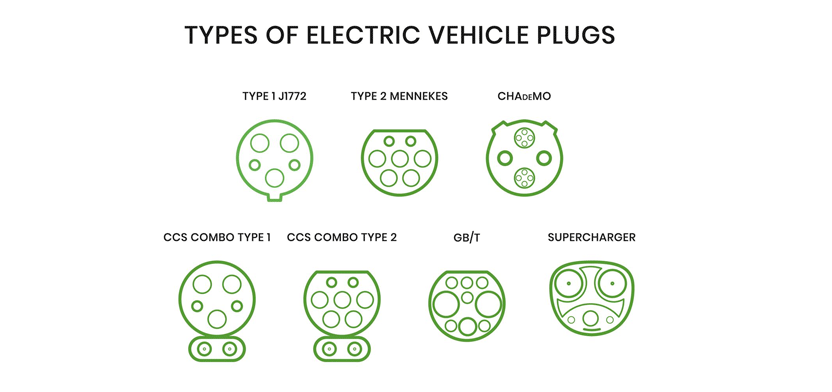
The fastest connections tend to be CCS, however Chademo and the Tesla version of the Type 2 connection are also deemed rapid or ultra-rapid and are fed by direct current (DC).
Type 2 connections are more common for fast charging providing alternating current (AC) at between 7-22 kilowatt (kW). These charge points may have a cable attached, but more commonly will simply be a socket and you’ll need to remember to bring your own cable.
The vast majority of new electric cars will take either a CCS or Type 2 connection. With all rapid DC, connections the charge points come with a cable already attached – known as a tethered charge point.
You can also find rapid AC chargers which are tethered.
Slow connections are those offering 6kW or less and most commonly use a three-pin socket, Commando, Type 1 or Type 2 connection. Again, most will also require you to bring your own cable.
Speed of supply
As we’ve mentioned, slow charging is anything offering 6kW or lower.
Fast charging is deemed to be between 7kW and 22kW. The next step up is rapid charging at between 43-100kW, while ultra-rapid is anything from 100kW and up. In the UK, the fastest you’ll find on a public charge point is 350kW.
Charging speed
The vast array of different speeds can seem daunting, however, there are a few simple points to remember.
Firstly, a dedicated home charging point is typically 7kW. At this speed to go from 20% charge to 100% in a car with a 70kW battery it will usually take around eight hours.
If you’re out using the public charging network, a more typical charge would be from 10-80%. On a 50kW supply, the same 70kW battery would take approximately an hour.
A supply at 100kW could take this down to less than 30 minutes.
However, advertised charge speeds may not match what is delivered in everyday charging and a host of factors impact the actual speed of electricity delivery. These factors can include how many other cars are using the same charging station, temperature and the car itself governing the flow to maximise the health of the battery or how full the battery is to start with.
Charge curve
In all EVs the charge speed is not a constant. The fastest charging happens when the battery has least charge. As the battery moves closer to being full, software in the car slows the charge speed. Many liken this to filling a glass with water. It’s easy to fill quickly at first, but as you reach the top you slow down. The way this happens in EVs is known as the charge curve.
Different makes of car have different charge curves and these can be governed not only by how full the battery is, but also the temperature and how much the car maker wants to protect the battery as constant fast charging to full can, in the long term, reduce the battery’s capacity.
Payment options
Most public charging points can be used with tap-to-pay and on-screen instructions that tell EV drivers how to connect and pay. Tap-to-pay is the simplest option but it may not be the cheapest option as some brands of charge point offer lower rates in return for a membership fee or registration for their services.
Those that don’t offer tap-to-pay will usually allow charging and payment through a mobile app which you will have to register for and provide payment details through.
Cost of charging
Charging up with electricity on the public network is often more expensive than using home charging and this is particularly the case if you have a low-cost off-peak tariff at home.
Charge costs are usually linked to charge speeds, so a 350kW point is likely to cost more per kWh than a 22kW charge point.
A few public charge points are free, but they’re rare and getting rarer.
According to Zapmap, the current* average price for a slow or fast charge is 56p/kWh and for a rapid charge it’s 81p/kWh (March 2024). As a reference the Government’s energy price cap for domestic electricity is set at 24.5p/kWh from April to June 2024.**
Based on these figures, the cost to full charge a 70kWh battery from empty would range from £17.15 at home to £56.70 at a rapid charger.


Driving

Charging
Get in touch
If you'd like to discuss your EV needs in more detail, please get in touch with your Arval Business or Account Manager.


Arval UK Limited (Whitehill House, Windmill Hill, Swindon, SN5 6PE). Registration number 1073098. VAT registration GB 202 1441 76 is authorised and regulated by the Financial Conduct Authority under registration number 312798.