

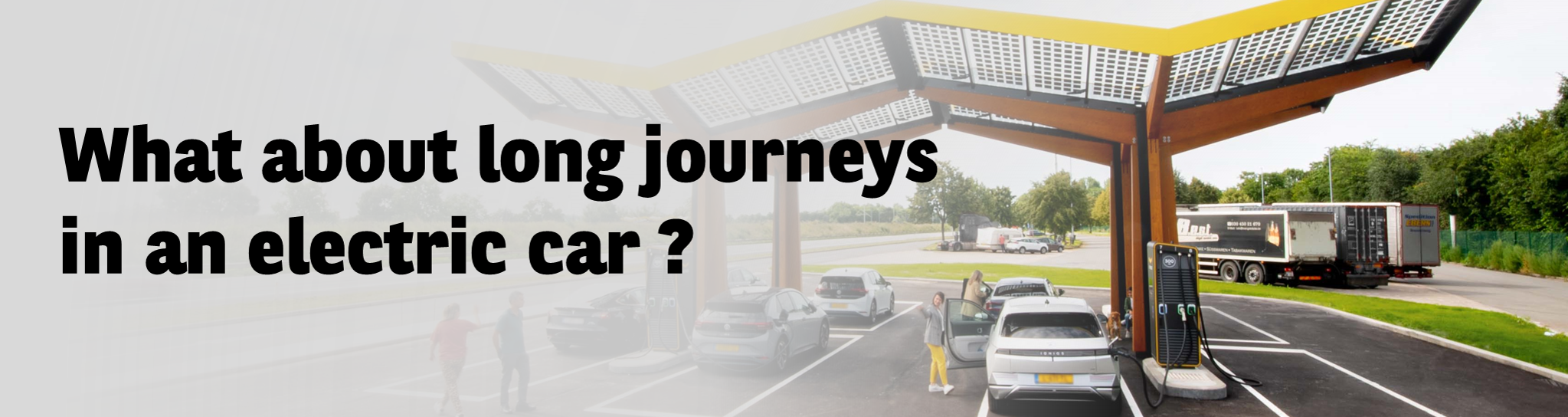
Making long journeys in an electric car : 10 key tips
As more drivers switch to electric vehicles (EVs), many will soon be embarking on their first long road trip in an EV likely requiring recharging along the way. Since range and charging are common concerns for new EV owners.
Here’s a 10-point guide to help make your long journey as smooth and stress-free as possible.
1. Plan ahead
Planning is crucial when it comes to covering long distances in an EV. If your journey will require on-route charging, it’s important to consider several factors: the range of your vehicle, the length of your trip, and how far you’re willing to deviate from your route to find charging points. It's also wise to plan for charging costs and check if you can charge at your destination.
Use apps like Chargemap, A Better Routeplanner (ABRP), or even your car’s own app to find and plan your charging stops. Google Maps can also help, especially for real-time traffic conditions, which may not be covered by charging apps. Some EVs will even direct you to nearby chargers when your range gets low, and more advanced systems will inform you if chargers are available when you arrive.
2. Know your charging options
Understanding the different types of charging points and how quickly your car can charge is key to optimizing your trip. If your car charges at 100 kW, there’s no need to seek out more expensive 200 kW+ chargers unless necessary. Conversely, if your car can handle faster charging rates, using these will reduce your stop times.
Be sure to confirm that the charging stations on your route have the right connector for your vehicle.
3. Understand your range
As you get used to your EV, you’ll become familiar with how accurate the car’s range predictions are and how environmental factors, like cold weather, impact performance. Cold temperatures generally reduce range, so it's good to keep that in mind.
A useful tip is to calculate your real-world range on the go. EVs typically display efficiency kilowatt-hour (kWh) per 100km. For example, if your EV achieves 20kWh per 100km and has a 80 kWh battery, your range would be (80/20)*100 = 400km. If you’re achieving 17kWh per 100km, your range would extend to 470 km.
4. Have a backup plan
The charging infrastructure is growing, but it's always smart to have a backup plan in case your preferred charging point is occupied or out of order. Traffic, diversions, or wrong turns can also affect your trip, so it’s a good idea to have extra range beyond the exact distance of your journey.
This will help ease range anxiety and ensure you’re never caught short.
5. Don’t give up on a ‘difficult’ charge point
If you encounter issues at a charging station, don’t immediately give up. Most charge points have a helpline printed on them, and in many cases, they can be reset remotely. If the payment system isn’t working, the provider may offer alternate payment methods or even compensate for the inconvenience.
6. Install helpful apps before you start
Apps are essential for both route planning and charging. While many public charge points accept contactless payments, the app of the provider often offers better rates. It’s a good idea to download the necessary apps and register before your trip to save time and avoid delays when it’s time to charge.
7. Use charging time efficiently
While your car is charging, make the most of the downtime. Whether it’s grabbing a bite to eat, attending a virtual meeting, or catching up on emails, use the charging stops to be productive.
Whenever possible, plan your charging stops at places where you’re likely to spend time anyway, such as at a destination with other facilities or tasks you need to complete.
8. Consider destination and return charging
Two factors often overlooked are charging at your destination and on the way back. If you’re traveling for business, try to book meeting venues with charging facilities. Even slower chargers can give you a useful top-up over a couple of hours. For personal trips, like visiting friends or family, simply plug in while catching up over a meal.
9. Think beyond just charging
When selecting charging stops, consider other needs like restroom breaks or meals. While most motorway services cover these basics, some smaller charging points may lack such facilities, so it's worth planning accordingly.
10. Learn from experience
The best way to master long EV journeys is through experience. The first trip often feels the most daunting due to range anxiety, but once you’ve successfully completed one, each subsequent journey becomes easier. As you get a better sense of your EV’s real-world range, you’ll fine-tune your planning and feel more confident for future trips.

ALL INFORMATION IN ONE PLACE !