

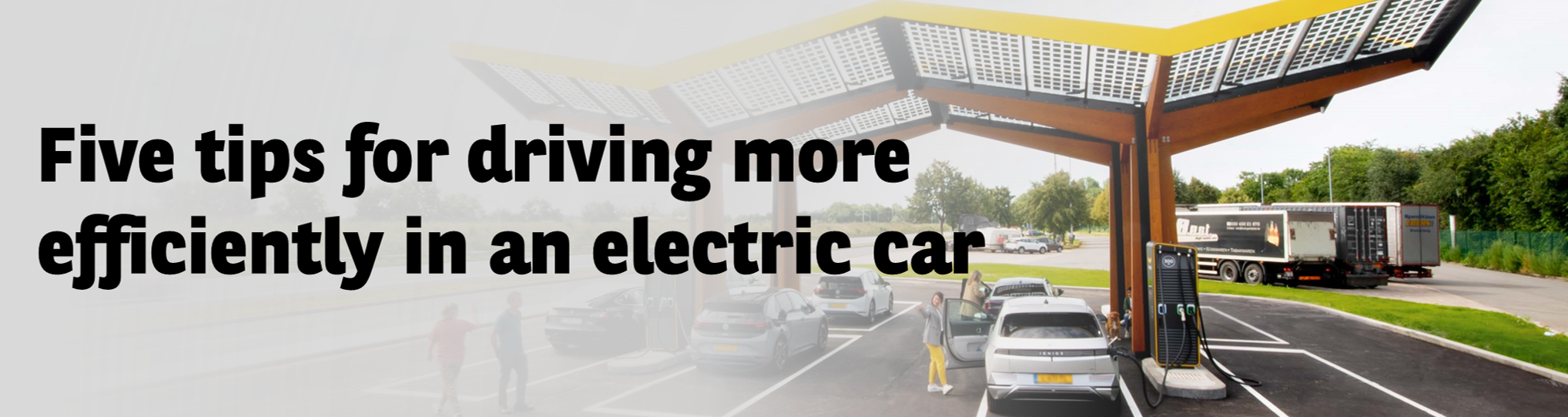
Driving efficiently in an electric vehicle (EV) can have a far greater impact than in a traditional petrol or diesel car because it goes beyond just fuel costs. Yes, driving more efficiently in any vehicle will save money on petrol, diesel, or electricity, but in an electric car or van, the benefits extend to increasing your range meaning you’ll need to stop less frequently to recharge.
For example, if you improve your efficiency by 20% in an EV with an 80 kWh battery, you could lower your consumption from 20 kWh/100 km to 16 kWh/100 km. This improvement increases your range from 400 km to 500 km, allowing you to cover significantly more distance before needing to stop and recharge.
So how can you drive more efficiently in an electric car?
1. Look ahead
Efficient driving revolves around keeping your car moving at a constant speed, reducing the need for frequent acceleration and braking. This is especially important in an electric car because starting and stopping consumes the most energy. One way to achieve this is by looking ahead and anticipating what’s going to happen on the road.
For example, is the traffic light ahead about to turn red or green? Can you time your arrival at a roundabout or junction so you don’t have to stop completely? Is there a downhill stretch where you can build enough momentum to help you ascend the next incline? By being more aware and planning your moves ahead, you can keep your EV moving more smoothly, using less energy.
2. Use brake energy regeneration
While observation and anticipation are good for efficiency in any vehicle, electric cars have a special advantage brake energy regeneration. This system recharges the battery when the car slows down. When you take your foot off the accelerator, the vehicle decelerates using a generator powered by the wheels, sending energy back to the battery.
If you press the brake pedal lightly, this increases the regeneration, adding more power to your battery without engaging the physical brakes. Only when you press the brake harder will the car stop using traditional friction brakes, which don’t recover any energy. By practicing smooth deceleration and reducing sharp braking, you can recover more electricity, ultimately extending your range and reducing wear on the brake pads.
3. Try one-pedal or paddle driving
Some electric vehicles go even further with "one-pedal driving." In this mode, lifting your foot off the accelerator applies the brakes to a degree that can eventually bring the car to a complete stop, capturing as much energy as possible along the way. This allows you to drive using only the accelerator in most situations.
Additionally, some EVs have paddle shifters on the steering wheel that allow you to adjust the level of brake energy regeneration manually. By pulling the paddles, you can increase or decrease the regenerative braking, effectively using them to control your speed without touching the brake pedal. One-pedal driving and paddle-controlled regeneration take some getting used to, but once mastered, they’re incredibly efficient, especially in city driving. If an emergency stop is required, the regular brake pedal still works as normal.
4. Pre-conditioning the car
Most electric cars come with connected services, which allow you to control certain features of the car via a mobile app. One of the most useful features is pre-conditioning, which lets you warm up or cool down the cabin and get the battery to its optimum operating temperature while the car is still plugged into a charging point.
By pre-conditioning the car before you even begin driving, you ensure that the battery is working at maximum efficiency right from the start of your journey. This helps to maximize your range, especially in extreme weather conditions. On top of that, it’s a comfort feature stepping into a perfectly warm or cool car, with no need for defrosting or air conditioning adjustments, is a bonus.
5. Use satnav and digital maps
Many electric cars are now integrating their brake energy regeneration systems with satnav data to enhance efficiency. When activated, these smart systems will automatically adjust the level of regeneration based on the road ahead, using information from the navigation system. For example, the car may increase regeneration on a downhill stretch to recapture more energy or reduce regeneration when approaching a hill.
Satnav systems can also suggest the most efficient route to your destination, helping to minimize energy consumption. Some mapping services, like Google Maps, now allow you to specify your vehicle type, whether it’s electric or fuel-powered, and will show you the most energy-efficient or fastest route based on your preference.
Even if you know your route well, it’s a good idea to use your satnav or digital map for maximum efficiency. These systems can help you avoid traffic, suggest better routes, and even plan charging stops if needed.
By incorporating these strategies into your daily driving habits, you’ll not only improve your car’s energy efficiency but also extend the range, allowing you to drive farther between recharges. This makes electric driving even more convenient and cost-effective, while also reducing the wear and tear on your vehicle.


ALL INFORMATION IN ONE PLACE !